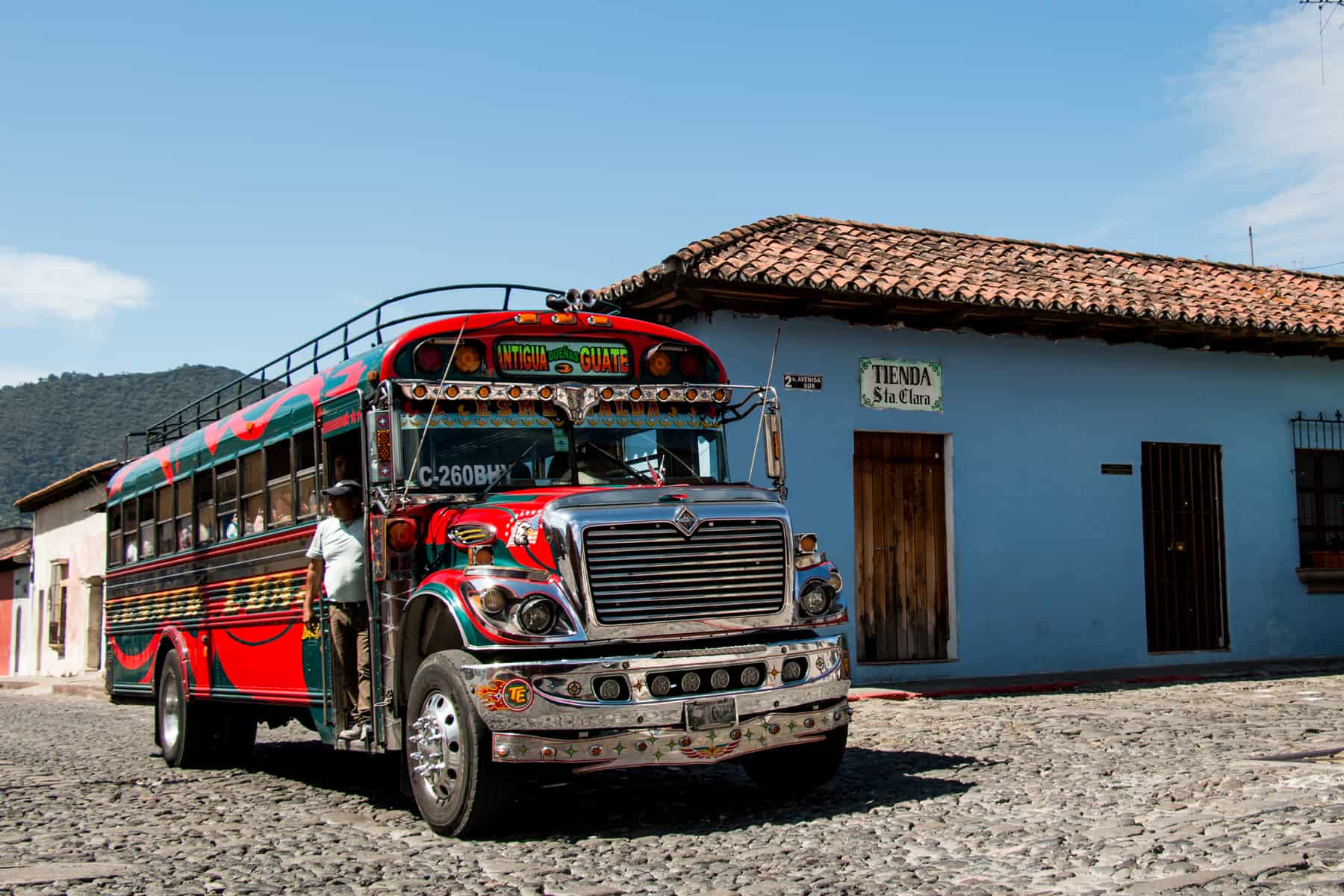
Taking local transport while travelling is one of our favourite ways to really experience a destination. It’s far more than simply a mode of transport, it’s en experience. And the legendary chicken buses of Central America are some of the best in the world.
There are few experiences like taking a chicken bus. For many backpackers, it’s a right of passage, even a badge of honour, to travel this way. They’re not just exciting, they’re affordable. And, much like visiting a local market, they provide a glimpse into the culture you won’t find by visiting museums.

This post may contain affiliate links. We receive a small commission when you click them or make any purchases. It doesn’t cost you anything extra. We only ever recommend products and services that we stand behind. Read more in our Affiliate Disclosure
What Are Chicken Buses?
The short version is that chicken buses are retired school buses from North America. Due to traffic safety regulations, when a bus reaches a certain number of miles, usually just over 100,000 (160,000 km), they’re retired from service. The buses are then auctioned off for private use or sent to the scrap yard.
Thankfully, in part to the relative lack of traffic safety regulations in Central America, this is where many old buses end up. Here, they’re given a new life and live out their remaining days until there’s nothing left to give.
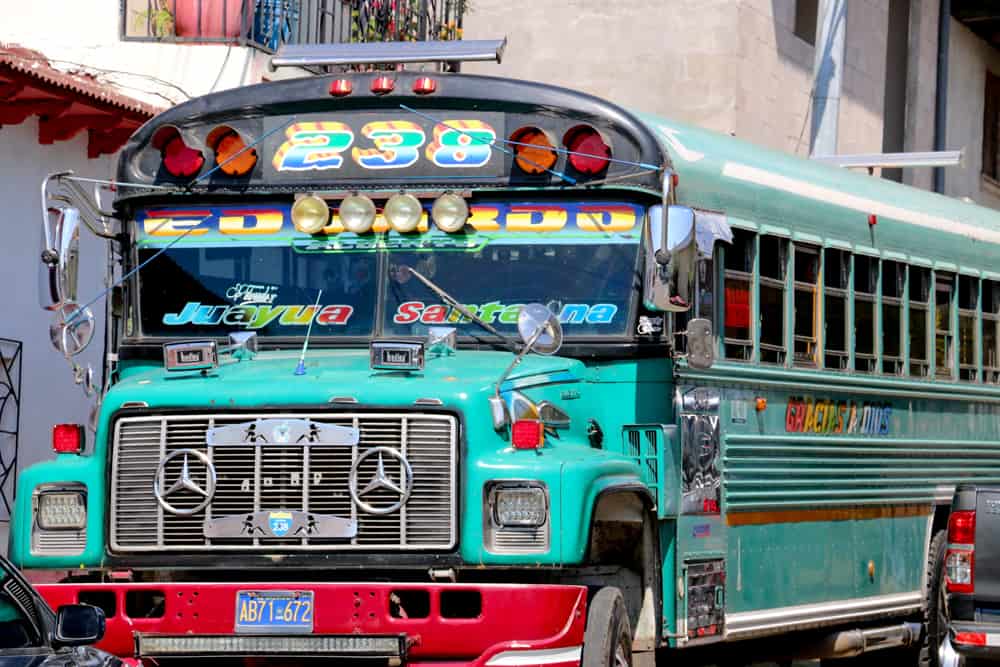
The more exciting version would state that these former school buses become chaotic carnivals on wheels. Brightly-coloured, often psychedelic paint jobs replace the standard orange-ish hue. Faux-chrome accessories adorn the diesel beasts, often in places they don’t belong.
What else doesn’t belong on a school bus? Spoilers. But these are no longer school buses, so to hell with your rules! Stickers and decals cover windows mirrors and windows, either religious figures or American brands (I lost count how many giant chrome “Apple” logos I’ve seen plastered on bus windows).
Beads, statues of Jesus, and photos of bikini-clad women, torn from magazines, fill up any remaining window space. Custom sound systems blast, often at deafening volumes, everything from 90s dance music to 80s power ballads to current Latin hits.
Why is it Called a Chicken Bus?
They get their curious name from the fact that locals often use them to transport almost everything, chickens included. Aside from day-to-day items and luggage, we’ve seen locals load all kinds of different items on the roofs of these buses.
People pack ladders, furniture, doors, shelving units, and prepared food to sell at the market. As well as toy displays, racks of cotton-candy, pails of fish, goats, and of course: chickens.
What Makes them So Special?
The reason we love these buses is for the incredible, though sometimes uncomfortable, experience. Aside from the blaring music and unique cargo, the ride is almost always completely packed with people. It’s not uncommon for every seat to sit three people, with many more standing (or sitting) in the aisles.
You never know who may get on at each stop. Food vendors are most common, selling everything from bottled water and juice, to candies, fruit, fried treats, steaming tamales, and all sorts of delicious snacks. Sometimes a salesman will board, selling wares across the spectrum. We’ve encountered basic items such as flashlights and wallets, to skin cream, questionable pharmaceuticals — even hand-held tasers.
In El Salvador, it’s very common for a street preacher to get on board and shout an impromptu sermon at the semi-attentive crowd. All of them, hawkers, salesmen and preachers alike, hop on at one stop, and jump off a few farther down the road, repeating this act back and forth throughout the day.
The ride itself is often an adventure. These buses often travel at questionable speeds, usually on roads not fit for such velocities. I imagine it’s only ever after retirement that these speedometer needles spin so far.
Overall, what makes these so much fun to ride, is that you’re forced to get comfortable with those around you. And even if you don’t speak the same language, the universal tongue of experience is shared by all.

Where can you Find Them?
Chicken buses are found throughout most of Central America. However, where you’ll encounter them the most are in Guatemala, El Salvador, Honduras and Nicaragua.
I’m assuming that this is mostly due to the generally higher number of people requiring cheap transport, combined with typically more stringent regulations in neighbouring countries.
While chicken buses almost always leave and arrive from set locations, everything in between is fair game. Most will follow the same route, but will occasionally make random detours to avoid heavy traffic. Sometimes the driver will take a side trip to grab a bite to eat. As for where they stop en route, buses will stop for anyone willing to pay — hence the overcrowding.
Riding a Chicken Bus
To take a chicken bus from a main city or town, first, ask around where it leaves from. Usually, all buses leave from the central bus terminal, but this isn’t always the case. For example, if you’re taking the bus from Antigua to Lake Atitlan in Guatemala, the direct chicken bus leaves from a road next to the bus station.
In some cities in El Salvador, the bus “station” might just be an intersection, and occasionally different buses leave from different crossings. Always ask around with locals, or at your hostel, about where to catch your specific bus.
If you’re in a smaller town or trying to catch a bus on the side of the highway, it’s as simple as waving your arm to indicate to the driver that you’re looking for a ride. When you get on, it’s a good idea to tell the driver where you’re going. This is important for two reasons. First, he can confirm whether or not the bus is actually going there. As well he, or his assistant, can let you know where to get off if for some reason it isn’t at the main terminal.
If you do know where to get off, or need to get off at random (for whatever reason), just whistle or holler at the driver. This is how the locals do it.

Chicken Buses are Cheap!
Costs vary from country to country, but overall this is the cheapest method to get around. You’re likely to pay around $1 – $2 for roughly every hour of travel. This is a very general guideline, but it’s fairly accurate. For example, in El Salvador, the two-hour trip from El Tunco to San Salvador costs around $2.00. The three-hour direct bus from Antigua to Panajachel, in Guatemala, costs $4.00.
Payment works differently from bus to bus as well. Most of the time, you just hop on and wait for the attendant to come by, usually juggling his change purse. Other times, though less common, you’ll pay the driver and cross a turnstile while boarding.

Are Chicken Buses Safe?
This is something that is brought up to us constantly. People are either asking us if they’re safe or telling us that they aren’t. We’ve ridden chicken buses dozens of times. I’d say well over 50. And not once have we felt we were in danger.
Yes, these buses tend to drive a little faster than they probably should. And yes, they’re often in a state of questionable repair (they were retired for a reason, after all). But the likelihood of anything happening isn’t much worse than taking a fancy, air-conditioned shuttle (at 20 times the price).
The biggest concern while riding chicken buses is theft. Petty theft is common in Central America, so be sure to take the same precautions you would anywhere else in the region. Keep your belongings close, don’t flash expensive items (like cameras, jewelry, etc.), and avoid taking buses at night.

Enjoy the Experience!
They’re far from comfortable, rarely relaxing, never air-conditioned, and almost always overcrowded and chaotic. But they’re one of our favourite ways to travel.
For one of the most real experiences you can have, while travelling through Central America, do yourself a favour and travel by chicken bus – even just once.

Related Articles


Like it? Pin It!


About the Author
